I had this great physical therapist this year. She worked with me to run again and set my own movement goals. I started checking out other online options for improvement and maintenance, being gym-less now in the end times 😉
I decided not to buy anything from any of these guys in the headline. The big turnoff? Macho, bootstrappy bios with no acknowledging of history, influences, or context.
I found a ‘history’ of physical fitness that never mentions women or anything non-European* and even it talks about the gymnasiums of the 19th century, and that as humans we were used to “running, balancing, jumping, crawling, climbing” in the distant past. ‘Crawling’ being that thing that the movement cultures adopt, slightly vary, re-name, and appropriate 😉
Imitation of animals is straight out of of ancient dances, sport, and rituals. Capoeira has a long-referenced history to African dance like Mohobelo, the “striding dance” of the Sotho with “leaping, kicking, sliding, and sinuous movements close to the ground.”
Capoeira is a geneological ancestor, according the dance community, including the b-boys that GMB and others will acknowledge. The backbend/wheel is 19th century yoga asana, that even then didn’t appear out of thin air.
Similarly this Tree of Dance – ahem – this Euro-American tree of dance (with its nod to capoeira) ignores Asia, Australia, Polynesia (the cultural appropriation of ‘hula’ and ‘belly dance’, pls?) and other combat arts everywhere.
My favorite beachbody guy didn’t claim to invent the abs exercises he put together in a sequence. I bought it anyway. The point wasn’t that he’d reinvented the wheel (ouch). Ido referenced capoeira in the past, but is now distancing himself, Mike F just avoids the question, and the GMB guys say they’ve never done it.
GMB posts videos of elderly martial arts gurus who they claim to respect. Gurus who likely teach their students the history and context of their art. They also have a ‘discussion’ page that is comment-free and focused on the argument that movements do not ‘belong’ to gymnastics, capoeira, or yoga.
True, but if you’re doing a downward dog, bro, just say it. There’s also a signature move, the downward dog of capoeira (not ginga) that Ido, GMB, and Animal Flow do, unmodified. What else do these novo gurus have in common? Omitting history and influence, saying things like they’ve been ‘doing these movements for 30 years.’ Thinking they invented the alphabet after just writing a good essay.
So… I’ll take what I like and leave the rest. With a little help from my therapist 🙂
Yes, the article was written for a site called “the art of manliness” – but the article isn’t titled “the history of physical fitness in men in europe,” – it’s “The History of Physical Fitness.”
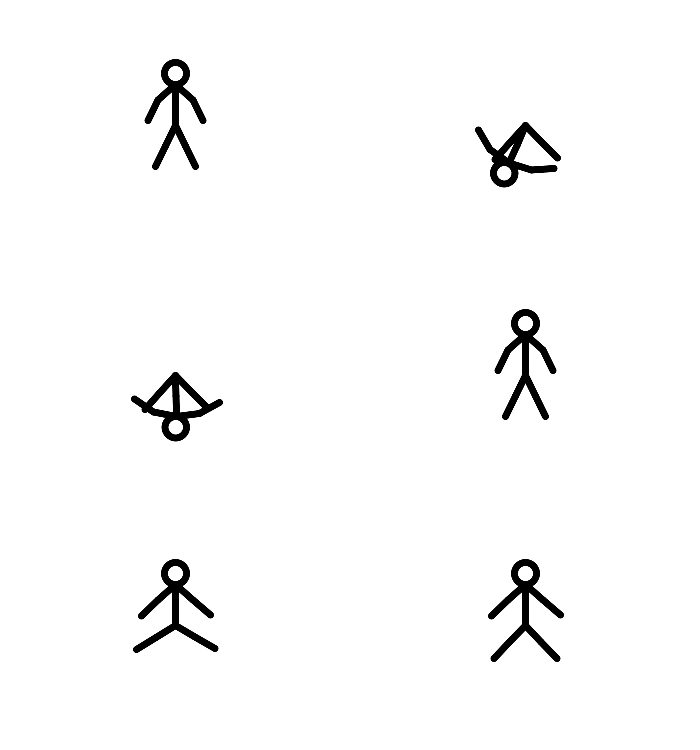
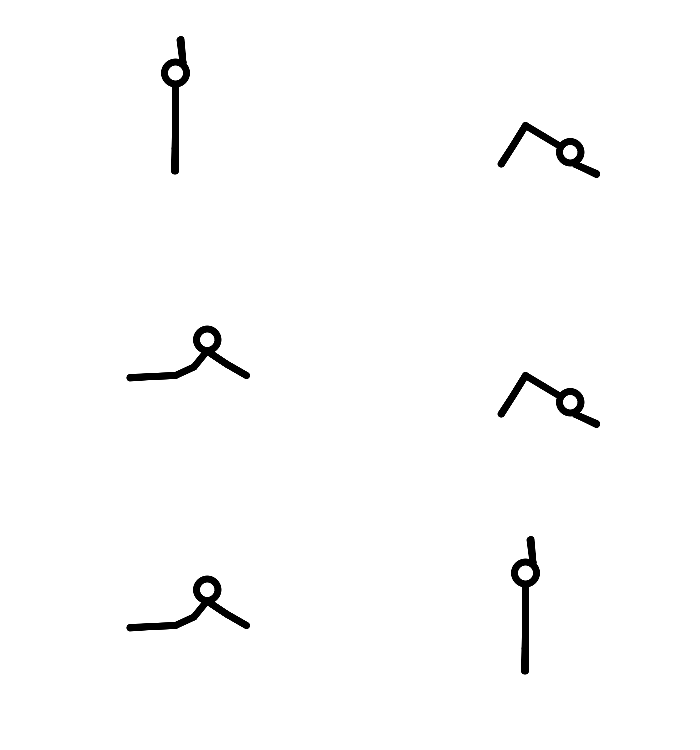
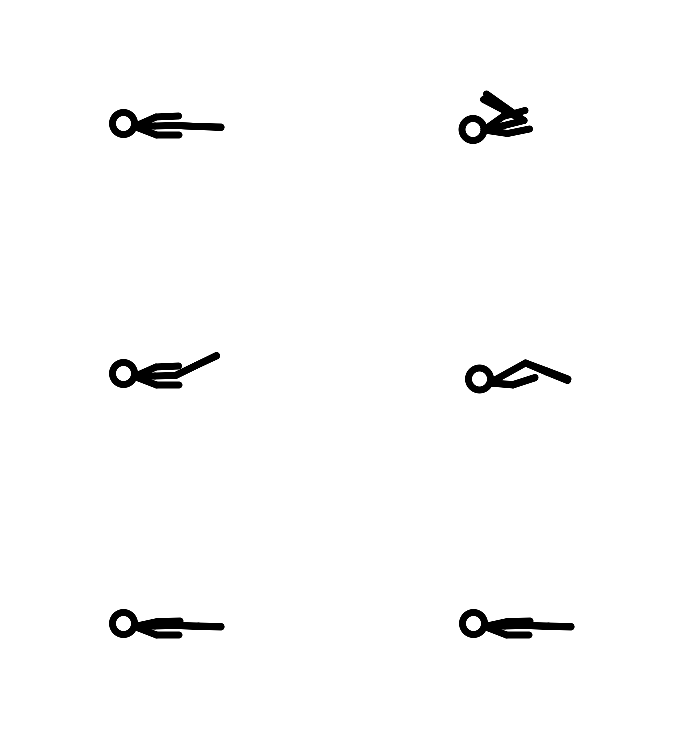
This is what I try to do every day, more or less, in about 15 minutes. (Before I do physiotherapy.) The stick figures are more visual cues than explicit instructions.
(Optional: The first 5 can be done on a vibrating platform: precede it with qigong tapping and do a one minute plank after #5.)
1. Vertigo / Balance Exercises
Head turns in 3 planes: up/down, side to side (ear to shoulder), and facing L/R. Slow head rolls in both directions.
2. Shoulder ROM
Small arm circles front, side, overhead. Single arm circles, front to back, large. (Optional: add hand weights)
3. Core ROM 1
Reach overhead L+R. Lean L+R w/o moving hips, then moving hips. Stand in place, twist to face the back. (Optional: add hand weights)
4. Shoulder ROM 1
Air traffic controller arms (elbows out to the side, 90deg to wrists that move fwd/up. Arms straight out to sides, fists with thumbs rotating up/down. Cactus arms, bring elbows in/out. (Optional: add hand weights)
5. Core ROM 2
Hip circles. Torso circles (head down). ‘Marilyn Monroe’ hip hikes. Says my PT 🙂
6. Shoulder ROM 2
Isometric scapula squeeze. Doorway pec stretch.
7. Hamstring & Quad ROM
Standing, v legs, lean fwd, L, R. Squat lunges L and R.
8. Yoga ROM 1
Down dog, up dog. Yoga bow (not shown).
9. Yoga ROM 2
Each side: In d-dog, circle each leg with max ROM. Warrior 1 Warrior 3 (lean back) Triangle pose Right angle pose Crescent, then stretch hamstring Reverse right angle pose Something I do that’s not yoga Pigeon
10. Lower Body Stretches
Figure 4 stretches Butterfly Twists Sitting V stretch Pike (L/R/both)
11. Low Squat
12. Pelvis + Spine
Yoga plow. Bridges with ball. Foot to knee pelvic rotation correction.
13. Swallowing: PT For Dysphagia
Head raises (prone). Chin tucks at multiple angles.
14. Balance
Left and right: Balance on one foot: leg straight and forward, rotate wrists and ankles. Knee to shoulder, ankle and quad stretches. Yoga dancer pose. Yoga one-leg poses: straight to front, side, then one-leg chair. (Optional: add handweights, do these balancing on a half-ball platform.) Yoga tree pose L + R.
I traveled for a lot of 2019 and 2020. I didn’t get much proper exercise, though I kept up with a version of the 2019 routine enough to maintain the ability to do each movement. It’s gotten a little longer and I’ve split it into alternating day routines that, given enough energy, I could complete in about 45 minutes. I’ve rarely been able to make it through without being exhausted. Some days I finish late, doing parts throughout the day. Other days I just get done what I can. Sometimes I spend the entire day trying to get the energy to exercise.
About 7 weeks ago, I started strength training again. An old-lady zoom program I get free with Medicare. I could hardly keep up with my mom. She takes it at her pace, but moves constantly for the entire 45 minute class and then often goes to another one.
*HIIT: During the cardio part of the circuit classes, I do 50 jumping jacks as fast and hard as I can. It’s about 30 seconds each of high intensity per set. The goal is 4 sets, plus an extra set of jumping rope.
*Diet: Creatine pre workout, BCAA post, high protein (1g/lb) diet, adding casein just before bed.
The schedule has organically increased in frequency. It wasn’t planned. I just got strong enough to do more. And mom is pretty insistent. Or regimented. Or something. I asked why and she had a one-word answer: ‘fear.’ Of? Being bedridden. Not able to move herself. Being in pain.
I’m not sure what I’m afraid of. But I hope I can run again. Even for just a few minutes a day. 🙂
Related to Huntington Disease? I don’t know. Maybe it’s the autoimmune genes fault, this time.
2019
Episodes of vertigo started 15 years ago – severe, but not frequent. Sometimes it would put me in bed for a week. Changing position incrementally (I couldn’t just sit up from bed), I’d have to gradually tilt my head about 15 degrees up and wait a minute.. repeat until sitting. Now it’s persistent but subtle, about half the time, with a duration of a week or two.
Suggestions for people with Ménière’s disease and other vestibular disorders: regulate intake of food and water so that there are fewer *fluctuations* in sodium input and blood sugar levels. Avoid alcohol, caffeine, and MSG, and stay hydrated.
In 2003 I had a doc suggest that I drink alcohol for its diuretic properties. It was somewhat successful, but it’s hard to tell since I was also reducing sodium. I’m more likely to have a mild episode that lasts a few hours after eating a lot of salt, which typically I don’t. BPP exercises (the Epley manoever is one) doesn’t generally give much relief – it worked once in 2012.
What Works For Me
Every morning I do a set of exercises my mom’s physical therapist gave her and it has reduced the severity. The debilitating episodes happen only once every year or two. Move the head in three planes, gently, to the extent of range of motion, and without discomfort: * chin up and down supporting the neck in the back * looking left and right without moving the chin higher or lower * tilting the head left and right while keeping the face forward and the shoulders down
I’m also targeting balance more generally. Walking heel to toe on a treadmill (on it’s very slowest setting), walking on the treadmill while doing the head-ROM exercises, standing on a balance trainer and doing them (with a wall for support). The mantra: find what is hard and do more of it. In 2016 I had my first surf lesson in the middle of a week-long mild episode. It was definitely harder, but doable. 😉
I’m constantly in the process of creating an exercise routine that works best for me. A lot of practices claim they’re a fountain of youth: qigong, yoga, 20th century fitness, and 21st century ‘movement culture’. My goal is slowing the progression of HD. My quest is for something similar, even if I’m reluctant to admit it. I don’t want to live forever, I just want to live with the best quality of life.
Learning to Juggle. And Hackeysack.
My body isn’t the same from year to year (or day to day), so it needs to have a core set of goals that can be approached with flexibility.
Differences in anatomy and physiology (visible or not) aren’t built into any system I’ve studied so far. The tall, lanky basketball body versus the sprinter versus the gymnast. Differences in fast/slow twitch muscle fiber ratios. Tendencies to build muscle or not. It’s also super-important to consider pre-existing injuries and tendencies to re-injury. Most systems work for one or two body types better than others. None work for me unmodified.
Incorporating Multiple Movement Systems
I’m ignoring systems designed to achieve some spiritual purpose (Kundalini yoga, Gurdjieff movements) unless they have integrated movement and fitness goals. Great stuff, but incorporated into other daily practices. Here’s a summary of my sources.
Hatha Yoga / Pranayama
The standard Ashtanga flavors of yoga have a lot of variation to offer, but I have to modify in a couple of ways. Long-held static postures are a no-go. It makes my joints and tendons stiff. My body doesn’t care if it’s sitting on the couch, cross-legged for meditation, in corpse pose, or in an active balance. If it’s too long, it causes pain and seems to be counterproductive. This rules out Bikram and Iyengar. Forward folds have to be limited: I have two torn tendons in my hip, one being a hamstring. All it takes for me to be out for weeks is to get serious in a folding-intensive class. Once.
Qigong
I’m looking at Yi Jin Jing for specific movements and combining energy work with the exercises, from qigong or other sources. “You can do vital breath through everything” – my instructor. The stimulation from tapping seems to increase proprioception. People with HD misperceive where their bodies are in space. They won’t be aware that a hand is waving like it’s trying to flag a taxi. They often have injuries they don’t even notice.
20th Century Exercise Routines – J.P. Muller
In the 20th century, pre-physiologists like J.P. Muller and Eugen Sandow created daily exercise routines. Muller’s goal was lifetime fitness, Sandow focused on building muscle and strength. What they have in common with qigong, tai chi, and yoga is an emphasis on how to breathe while moving. Muller even wrote a 2nd book on his breathing exercises and focuses on fluidity in the movements. Muller created something that could be done daily, in 15-20 minutes.
21st Century Fitness: ‘Movement Culture’
Ido Portal took notes from Claude Victoria and capoeira. He stripped movement from context and created a philosophy of physicality based on play. Actions are given degrees of freedom and spontaneity that linear, proscribed fitness routines and physio training lack. That reduces the repetitive motion issues quite a lot. I’m not into the extreme sport aspect of it: the one-handed handstands and flagpoles. I am one of the “people who weren’t willing to train many hours a day, six or seven days a week”. I met a movement guru who is more interested in the physiology and adaptability, and incorporating philosophy and health rather than competing like a bro.
Sport and Physical Therapy
I’m excluding sports generally and endurance sports in particular. They’re out mostly because I don’t have the coordination (HD), but some were off the table earlier. This is not a humblebrag, I’m more of an experimenter than an athlete: I stopped triathlon training, HIIT sprints, and roller derby when I tore a hamstring in the 2000s. In the early 2010s, I took classes in trapeze, silk arts, parkour, crossfit, and gymnastics. I started climbing and capoeira. The repetition of sport-specific training was too intense. Hand-intensive and impact-heavy sports were dropped because of the joint issues and tendinopathies: crack climbing, silks, parkour, gymnastics. I tried surfing (because I was terrified of being alone in deep water) and got surfer’s neck and flared a shoulder tendinosis from paddling out. What playing with sports gave me was a range of training styles, exercises, and intensities.
Physical Therapy
After spine, hip, and knee injuries I went through several rounds of physical therapy and realized I didn’t need to spend 3 hours at the gym every other day to make a difference in how I move and feel. I’m taking anything from PT and sports that hits a sweet spot: particularly efficient movement that exercises an otherwise overlooked area of my body. Rolling the IT band, wall squats, vibration therapies, superman (dorsal core, good for HD dystonia and ruptured disks).
Capoeira
The Afro-Brazilian (martial) art capoeira, is evolving proscribed movement (like a sport) and a philosophical worldview. What it has that other paradigms lack are the focus on inversions and balance in motion. Using the arms as much as the legs for stability on the floor adds a lot of fall resilience. Since I’m given the ok to modify in class as much as I need, it’s the only sport I’m (occasionally) continuing.
Thanks, Mom
Later than anyone would have expected her to be exercising, and long after she couldn’t drive, mom was at the gym. She was in much better shape than her family members at the same age with HD. She “went to the Y for a yoga class.” Not mentioning the 20-odd minutes of cardio on the bike she did before walking (with her cane) to each of the weight machines. Before yoga class. Mom’s the reason I’m including the strength training, too. HD increases bone loss as well as muscle loss.
Goals
The ultimate goal is a short, easy to remember, daily routine that incorporates everything in this checklist.
Breath and Energy (Pranayama/Qigong)
Complete ROM, All Joints (Fluid/Non-Impact)
Core Fitness
Neck and Spine Flexibility
Extremities Strength and Flexibility
Inversions (Lungs and Spine)
Tapping, Vibration (Proprioception)
Balance
Non-Impact Cardio (Heart and Lungs)
Oh, and under 40 minutes.
Routine Cheatsheet, 2019
Details of the new 2020 routine (and an explanation of the 2019 cheatsheet) in a later post. I’m planning to post a breakdown of each of the movements, its purpose and effects.
Hopefully what you’d take from my process is not my routine – but how to create yours, starting with your goals and listening to your body. Experimenting and noticing reactions, short and long term.






 Mastering The Decline